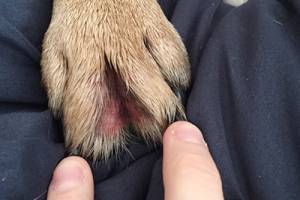
While injury (e.g., being hit by a car) can typically cause bruising in dogs, simply playing or rough housing should not normally result in bruising. That’s because dogs have a thicker skin (skin) and coat that safeguards them from bruising more than it does for human beings. As an outcome, when we see dog bruising, we worry about an underlying platelet problem or clotting issue.
What is a bruise
The term bruise or “hematoma” is a collective term, since there are several varieties of this phenomenon with their own characteristics of manifestation. The general concept of this term implies the presence of a rupture of blood vessels, as a result of which there is hemorrhage into the adjacent tissues and cavities.
The treatment of such an injury depends on the area of the contusion, the presence of tissue rupture, and the type of hematoma. After all, small bruises and hemorrhages that are received in everyday life during normal leisure activities are often not too dangerous. You can help your pet if you get them yourself.
If the hemorrhage or injury was caused by an accident, a fight with other animals or a fall from a sufficient height, emergency treatment by a doctor may be necessary. The generally accepted classification of hematomas makes it possible to understand how serious the injury is and whether professional medical attention needs to be sought.
Hematomas can form almost anywhere on the pet’s body: on the side, head, paw, back and stomach. And if on the paws, abdomen and tail the abrasions and injuries can be healed and licked by the animal himself, on the head and back it will be difficult for him to do it. This is why bruises in places that are hard to reach require special attention from the owner.
Types of bruises
The division of bruises into types is carried out according to several indicators. So, according to the type of damage to a blood vessel or artery hematomas are divided into the following varieties:
venous – a variant of hemorrhage, which was formed by damaging the walls of the veins;
arterial – a variant of hemorrhage that is caused by a rupture of the arterial wall;
mixed hematoma – the result of damage to several types of vessels and capillaries, as well as veins and arteries;
the pulsatile variety is noted when there is a defect in the walls of the aorta.
In addition to the type of damaged vessel, hematomas are subdivided according to their location:
- intermuscular, in the development of which the hemorrhage is located between layers of muscle tissue;
- subcutaneous – they are located under the skin;
- subabdominal hematoma is localized in the area of the abdominal cavity;
- intraorganic – it is formed in the tissues of a particular internal organ;
- pararectal is located in the tissues of the rectum;
- when an intracranial hematoma is formed, blood accumulates in the cranial cavity.
Some types of bruises may cause no visible discomfort to the pet. In other cases, the dog may experience severe pain and immediate veterinary care is required.
Where Bruisings Appear?
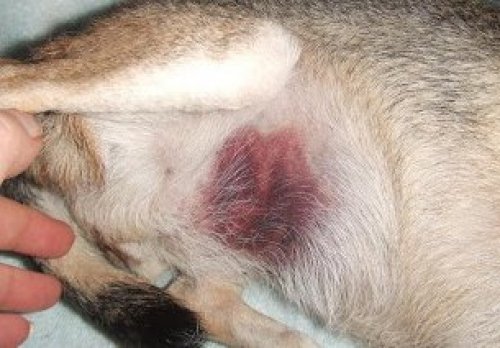
Bruising in dogs is never normal, and signs of determine contusions (called petechiae) or larger bruises (ecchymosis) require an immediate journey to your veterinarian. Obviously, your veterinarian will dismiss more benign causes (such as hives or an allergic reaction that can look similar to a contusion).
Can bruising appear on dog’s belly? Bruising is most convenient to see on the gums of your dog, inside thigh, or on the belly (where there is less fur).
Symptoms
If you observe any signs of bruising, you and your vet will also have to make sure and rule out other medical signs of a bleeding issue:
- Blood in the back of the eye, providing a red hue to the globe
- Bleeding from the nose
- Small pin-point bruising of the skin (called petechiae)
- Larger bruises (called ecchymosis)
- Increased heart rate
- Difficulty breathing
- Increased respiratory rate
- Irregular bleeding from any orifice
Generally, the body’s ability to clot is complex and includes numerous stages and essential components such as tissue aspect, platelets, clotting elements, fibrin, and parts that break down fibrin. In certain diseases, the body loses the capability to clot usually and uncontrollable, deadly bleeding (i.e., hypocoagulability) or irregular clotting (e.g., hypercoagulability) might be seen.
Causes
Bruises and hemorrhages of various types and locations can occur for a variety of reasons. The pet may be mobile and active, resulting in more and more injuries of varying severity. Exploratory instincts, puppyhood and adolescence, when the dog is especially mobile, become the causes of bruises. Appearing at home in the normal activities of the animal, they may become invisible to the owner due to their rapid self-absorption. Because of the long coat, bruises that occur may also be unnoticeable. Animals treat their own bruises by licking and warming them.
However, there may be other causes:
- The result of a fight with other dogs or other animals. These injuries are often serious and require a visit to the doctor.
- Severe bruises, tissue tears, and broken bones that cause the walls of blood vessels and capillaries to rupture. Blood leaks out, accumulating in adjacent tissues.
- After surgical intervention. Micro-injuries during surgery are initially invisible to the eye, but with significant damage to the vessel walls, blood accumulates and forms significant swellings.
There are many situations in which a hematoma can form. Once the capillary or vessel wall has been damaged, the blood that accumulates in the tissue clots. It dissolves in the liquid parts of tissues and occurs with the participation of white blood cells – white blood cells. At the site of accumulation of clotted blood noted sprouting of connective tissue cells: this gradually forms a capsule. In it there is fluid. Thus a cystic mass is formed.
The cause of the appearance of hematomas even with minor mechanical damage to the walls of blood vessels may be their excessive fragility. This is a consequence of hereditary factors, malnutrition with a lack of necessary substances for the body. Can be diagnosed in older and weakened animals.
The occurrence of any injury affects the general well-being and behavior of the dog. Minor injuries do not entail serious health complications. However, attention must be paid to even small bruises and bruises: sometimes complications are likely to occur if they are not addressed.
The most common symptom of a bruise can be considered restricted movement of the animal. It may complain about a certain part of the body, not letting it be touched or trying not to act on it itself. When a limb is injured, a decrease in the dog’s use of it is particularly noticeable.
Also likely manifestations of a hematoma include:
- Deformity of the injured part of the body;
- an increase in temperature of the whole body (if there is inflammation in the tissues) or its part (in the place where the bruise or trauma occurred);
- An increase in lymph nodes is likely when an infectious process has begun to progress in the body.
Often dogs have an ear bruise. Even a slight impact with the paw when scratching is enough to traumatize the thin skin of the auricle. The danger of such a hematoma can be considered a high likelihood of secondary infection due to a bout of infection. It is quite easy to notice a hematoma with such a localization.
Diagnosis
To detect a bruise in time means to provide the necessary assistance to the dog and to ensure the quickest recovery of his health. First, an external examination of the pet is carried out. Probable places of injuries and bruises are examined. Any changes in the skin, adjoining tissues, limbs, and ears should draw attention during the external examination.
It is better to entrust the examination and diagnosis in case of a suspected injury to the pet to a veterinarian. He will professionally examine your dog’s body, checking each even small bruise or bruise in more detail. The most attention is paid to the areas that the dog complains about and won’t let him touch.
Once the doctor has found the lesion, it may be recommended that the doctor conduct a shaving of the hair on the part of the animal’s body where the bruise has been identified. This provides better access to the lesion and is necessary when performing therapeutic manipulations.
How Is Bruising on Dogs Treated?
After diagnosis, the doctor will prescribe the necessary therapeutic treatment. The veterinarian will determine the severity of the injury and the extent to which medication is needed. For small and non-threatening bruises, first aid and less stress on the injured part of the body will be sufficient.
First Aid
In the first few hours after a bruise, the pet should be kept as calm as possible. The pet feels anxious after the injury, tries to lick the injured area, does not allow to touch it. During the first 24 hours, the necessary help can be given at home, especially if the hematoma is small, the animal does not lose consciousness from painful shock or blood loss.
So, the following actions refer to the emergency care when a hematoma is detected:
- Ice is placed on the injured area, which will allow the blood to clot more quickly and stop bleeding within the tissues;
- remove the cooling bandage or ice after 10-15 minutes from the time of application;
- repeat the procedure of applying ice to the site of hematoma formation in 1.5-2 hours during the first 24 hours from the moment of injury.
After the swelling has ceased to increase in size a pressure dressing may be applied to the injured part of the body. It may be made of an elastic bandage. If the injury was not significant and the resulting hematoma does not cause noticeable discomfort to the pet, then further manipulation to relieve its well-being can be carried out at home.
For example, if the auricle has been injured and a hematoma has formed on the ear, with the dog not expressing much anxiety and the swelling not too large, it is possible to limit the first aid for the first 24 hours. Then the effect continues with the application of absorbing creams and ointments, light massage of the injured area. This increases the rate of blood flow and causes the hematoma to dissolve more quickly. As a rule, an ear hematoma is not life-threatening for the animal. However, there are exceptions.
Treatment at the clinic
There are a number of cases where the formation of an accumulation of blood under the skin is dangerous. The following causes of hematoma formation will require a mandatory visit to the veterinary clinic:
- The appearance of a large bruise or hematoma after being bitten by a dog or other animal. If the skin integrity of the bite is damaged, there is a high chance of infection entering the tissues and developing an inflammatory process;
- After surgery. If a dog has a hematoma as a result of surgery, it means that blood vessels and capillaries have been damaged and are too slow to heal;
- If there is a large hemorrhage that is dangerous for the animal;
- If the area of the injury has festered;
- a large size hematoma in the auricle.
In some cases there may be a risk of further hemorrhage after castration. This situation also requires monitoring and treatment in a veterinary clinic.
During treatment at the clinic, the doctor performs the following manipulations:
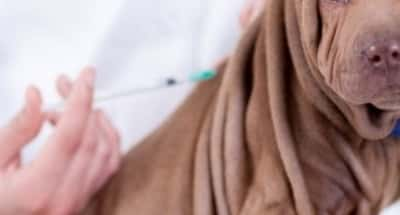
- The collected blood is removed from the tissue at the site of the injury and the formation of the hematoma with a syringe.
- A disinfectant solution and antibiotic are injected into the vacated area. This prevents the risk of inflammation.
- A tight fixation bandage is applied to the affected area.
If the operation is not necessary, or after it, the doctor prescribes a restorative treatment. With its help, you can accelerate the rehabilitation of the animal. A list of appropriate physical treatments is also prescribed, which will help to get the pet back active sooner.
Treatment at home
Treatment at home can be carried out when the bruise is small in size, does not cause much discomfort to the animal and does not pose a threat to its health. Rehabilitation of the injured dog is also carried out at home.
To speed up the healing process, the following manipulations may be recommended:
- light massage. With his help, it improves blood flow in the tissues. This contributes to a more rapid resorption of accumulated blood, relieves swelling;
- The use of warming procedures. Warming ointments and creams, compresses are used for this purpose;
- The introduction of vitamin complexes and immunomodulators in the daily diet.
The above actions at home are easy to perform, allowing you to quickly restore the pet and return him to activity and cheerfulness.
Medications
When hematomas of any localization are detected, the following medications are used:
- Disinfectants, which are used for external disinfection of the damaged area. These are iodine solution, Novocaine, Chlorhexidine;
- antimicrobial – used to prevent inflammatory and infectious processes (Levomekol ointment);
- For warming procedures, paraffin can be used, which is melted and applied in warm form to the site of the healing bruise.
Not bad proved itself heparin ointment, which is applied externally to the site of the hematoma. It provides a more rapid healing of the damaged tissue.
The treatment regimen should be prescribed by the attending veterinarian after examination. This will quickly get the expected results: elimination of swelling of tissues in the place of injury, acceleration of healing of the bruise, prevention of suppuration and inflammation.
Bottom line
Active pets are often injured and bruised, both while playing and socializing with their companions and as a result of their exploratory activities. A bruise or hematoma in a dog does not always require medical attention, but an attentive owner will always notice even a minor injury to their pet and try to help.